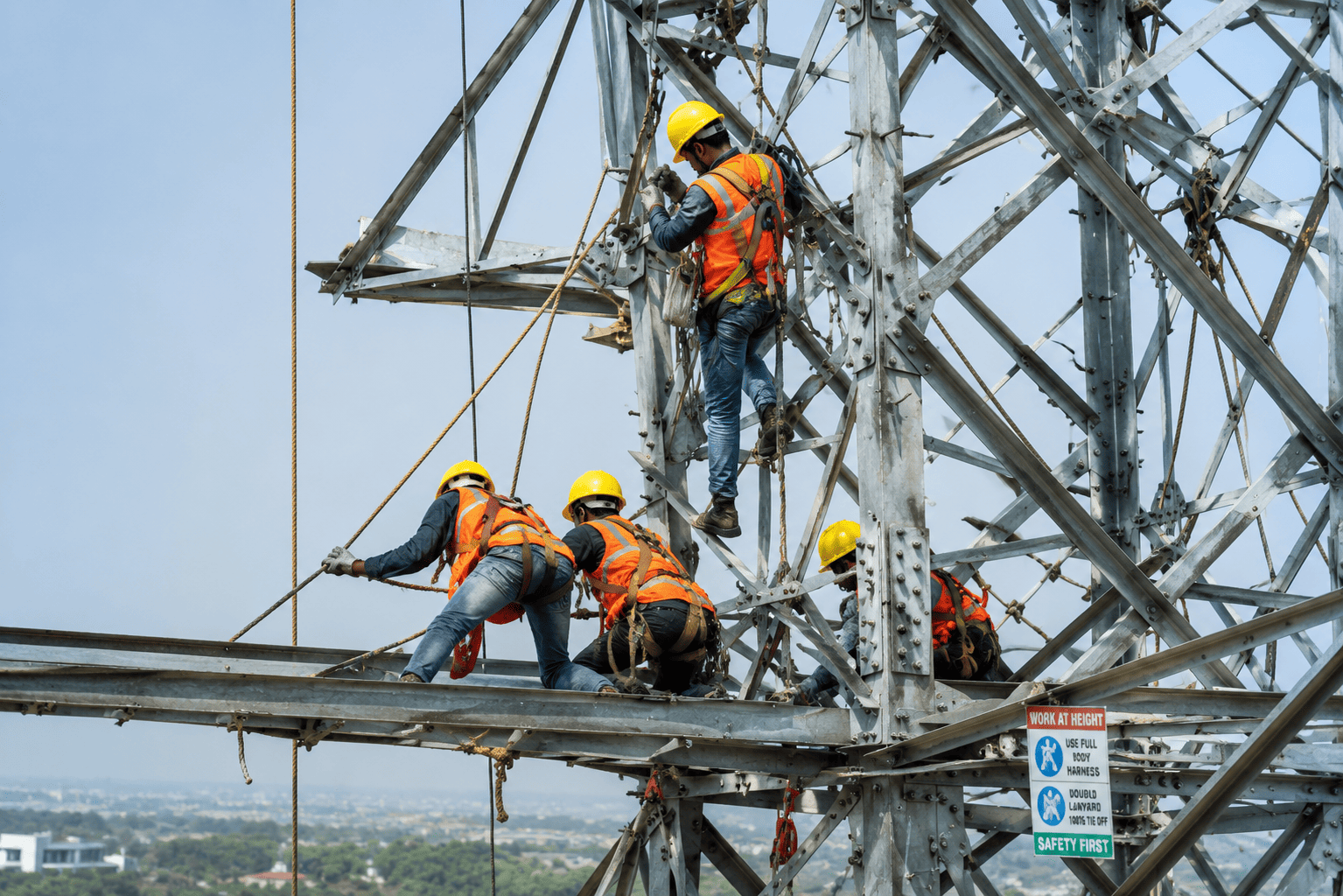
India is in the middle of one of the most ambitious telecommunications infrastructure expansions in its history. The rollout of 5G networks, the densification of 4G coverage in rural and semi-urban areas, and the maintenance demands of an existing tower estate that numbers in the hundreds of thousands have created a vast and rapidly growing workforce of tower climbers — workers who spend their professional lives ascending steel lattice structures, guyed masts, and rooftop installations at heights that leave no margin for error.
Falls from height remain among the leading causes of occupational fatality in the telecom infrastructure sector globally, and India is no exception. What separates a safe climb from a fatal one is not luck, weather, or circumstance. It is discipline — the disciplined application of eight non-negotiables that every tower climber must internalise and every employer must enforce without exception.
1. A Valid Permit to Work Before Every Single Climb
No climb begins without a completed, authorised permit to work. Not a verbal clearance. Not an assumption that yesterday's permit covers today's job. Not a rushed signature obtained after the climber has already geared up at the base of the tower. The permit to work is the documented confirmation that the specific hazards of this particular tower, on this particular day, have been assessed — that RF radiation levels have been measured and are within safe limits, that weather conditions have been evaluated, and that the structural integrity of the tower has been confirmed. Skipping or shortcutting this process is the single most common precursor to serious tower climbing incidents.
2. RF Radiation Assessment Before Approach
Radiofrequency radiation is the invisible hazard that distinguishes tower climbing from most other work-at-height environments. Active antennas on a live tower emit RF energy that, at close range and sufficient power density, can cause rapid and serious tissue damage — including internal burns that are not immediately apparent. Before any climber approaches a tower, and certainly before ascending to antenna level, a calibrated RF survey must be conducted to confirm that power density at the working zone is within ICNIRP occupational exposure limits. Measure before you climb. Every time.
3. 100 Percent Tie-Off at All Times
One hundred percent tie-off means that at no point during a climb — not during transitions between anchor points, not when shifting position on the tower face, not during the brief moment when a climber is moving from one structure to another — is there any instant when the climber is not connected to the tower by at least one energy-absorbing lanyard or a continuous fall arrest system. At twenty metres, impact velocity exceeds sixty kilometres per hour. Climbing without continuous connection is not a calculated risk. It is an uncontrolled gamble with a fatal probability.
4. Harness Inspection and Fit Verification Before Every Climb
A fall arrest harness is a life safety device, and like all life safety devices, its reliability depends entirely on its condition and correct application. Every harness must be inspected before each use — webbing checked for cuts, abrasion, chemical exposure, and UV degradation; buckles and D-rings examined for deformation or corrosion; stitching reviewed for fraying or damage. A harness that has arrested a fall must be immediately withdrawn from service, regardless of whether visible damage is apparent, because the energy absorption may have compromised its structural integrity in ways that are not externally visible.
5. No Climbing in Adverse Weather
Wind, rain, lightning, and extreme heat are not inconveniences to be managed on a tower. They are operational halts. Wind loading on a climber's body at elevation creates lateral forces that can overwhelm grip strength. Wet steel surfaces reduce friction dramatically. Lightning presents an existential risk to anyone on a metal structure elevated above the surrounding terrain. Heat stress at height, where exertion is high and shade is absent, accelerates fatigue and impairs judgment. Every tower climbing operation must have defined weather limits — specific wind speed thresholds, precipitation protocols, and lightning standdown procedures — and supervisors must have the authority to enforce them without pressure from schedule timelines.
6. Trained Rescue Capability On-Site Before the Climb Begins
A climber who becomes incapacitated at height — through a fall arrest, a medical event, a loss of consciousness from heat or RF exposure — cannot be reached by standard emergency services within the time window that determines survival. Waiting for fire brigade response to a tower rescue is not a plan. Every tower climbing operation must have at least one trained rescue-competent person on site who has completed hands-on tower rescue training and has practised these techniques under realistic conditions. Pre-rigging of rescue equipment before the climb begins is not overcaution. It is the difference between a recoverable incident and a fatality.
7. Competency Verification, Not Just Certification
India's telecom tower sector has a certification problem. Certificates are widely issued, inconsistently rigorous, and frequently treated by employers as proof of competency when they are, at best, proof of attendance. A climber who holds a working-at-height certificate but has never operated a descender under load, and has never experienced the physical reality of working on a narrow tower face in real conditions, is not a competent tower climber. They are a person with a document. Genuine competency verification requires practical assessment at realistic working heights, covering equipment use, emergency procedures, RF hazard awareness, and rescue techniques.
8. Never Climb Alone
Tower climbing is a buddy-dependent activity. A climber working alone at height with no ground-level attendant has no one to monitor their condition, no one to initiate rescue if they become incapacitated, and no one to call for help if communication equipment fails. The attendant on the ground maintains continuous communication, monitors for hazard changes at ground level, controls access to the base of the tower, and is the first responder if a rescue situation develops. Solo climbing saves no meaningful time. What it eliminates is the last layer of protection between an incident and a fatality.
India's 5G future is being built one tower at a time, by workers whose safety is entirely dependent on whether the organisations deploying them treat these eight non-negotiables as exactly what they are: the irreducible minimum below which no commercial or operational argument has any legitimate weight.