Walk into almost any post-training safety assessment across India's industrial sector and the scene is remarkably consistent. A stack of printed question papers. Workers hunched over clipboards or folding tables in a canteen or conference room. A trainer at the front of the room, watching the clock. Answers circled with borrowed pens on sheets that will be collected, manually scored, and filed in a folder that no one will open again. The ritual is familiar, the data it produces is thin, and its impact on actual learning retention is, to put it generously, limited.
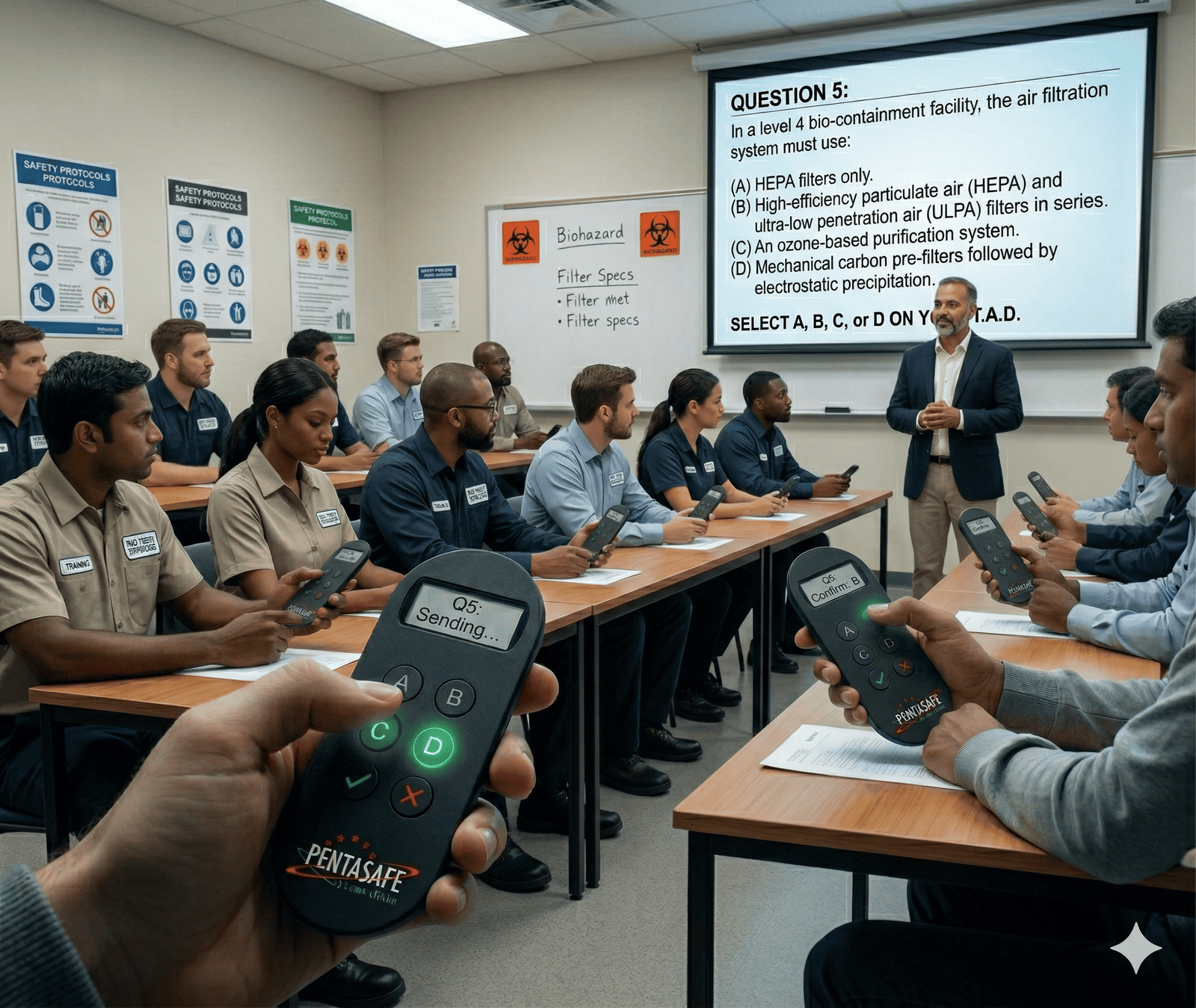
This is the state of safety assessment that TAD — the Training Assessment Device — was built to disrupt. TAD is a purpose-built MCQ assessment device designed specifically for safety training environments. It was conceived, developed, and refined with one specific use case in mind: making safety knowledge assessments more engaging, more accurate, more immediate, and more meaningful for the industrial workers who sit through them and the organisations that depend on the results.
The Three Failures of Paper-Based Assessment
To understand what TAD solves, it is worth being precise about what paper-based assessments fail to deliver.
Failure 1: Engagement. A worker who has sat through four hours of safety training arrives at the assessment phase tired, under-stimulated, and well aware that the sheet in front of them is a formality. Research on adult learning consistently shows that assessment, when done well, is not merely a measurement tool — it is itself a learning event. The act of retrieving information under a structured challenge strengthens neural pathways and improves long-term retention. A paper MCQ, administered as a formality, captures almost none of this potential.
Failure 2: Data. A paper-based assessment produces a score. It tells you whether a worker passed or failed the threshold. What it does not tell you is which specific questions were most frequently missed, which safety topics have the widest knowledge gaps across a cohort, whether a particular training module is consistently underperforming, or how one batch of workers at one site compares to another batch trained six months later. Without this data, training programmes cannot be improved and organisations cannot make evidence-based decisions about where their safety training investment needs to be deepened.
Failure 3: Immediacy. Paper assessments produce results after manual scoring — a process that takes time, introduces human error, and by the time results are communicated, has lost all immediacy for the learner. The moment of feedback, which is the most powerful moment for reinforcing correct understanding and correcting wrong assumptions, has long passed.
What TAD Does Differently
TAD addresses each of these failures directly and simultaneously. As a dedicated hardware device designed for the training room environment, it immediately signals to the participant that this assessment is different — that it is a structured, professional exercise that takes their engagement seriously. The physical act of using a purpose-built device creates a cognitive shift. Participants are more attentive, more deliberate in their responses, and more invested in the outcome.
Every response to every question is captured, timestamped, and available for analysis at the individual, cohort, and programme level. Trainers and safety managers can see not just who passed and who failed, but exactly where knowledge gaps exist. If a consistent proportion of workers at a particular facility are missing questions related to confined space atmospheric hazards, that is a signal that warrants immediate attention — either in the training delivery, the work environment itself, or both.
Results are available the moment the assessment concludes. A trainer can address misconceptions while the training content is still fresh, turning the assessment debrief into one of the highest-value moments of the entire training programme.
The Cultural Dimension
Beyond the technical advantages, TAD carries a cultural message that should not be underestimated. When an organisation deploys a purpose-built assessment device for its safety training, it signals to workers that their learning is taken seriously — that the organisation has invested in infrastructure specifically designed to measure and improve their safety knowledge, not simply to generate certificates. This signal matters in industrial environments where safety culture is built incrementally through thousands of small interactions that either reinforce or undermine the message that safety is genuinely valued.
Companies using TAD across Pentasafe-delivered programmes are reporting measurably higher engagement levels during assessments, more actionable data from their training audits, and a demonstrable improvement in the quality of post-training discussions between trainers and participants. In a field where the quality of knowledge can be the difference between a near-miss and a fatality, better assessment is not a luxury. It is a responsibility.