There are moments in the evolution of an industry when someone builds something so far ahead of its time that it reframes what everyone else believed was possible. The Safety Experience Center at JSW Steel's Dolvi Works in Maharashtra is one of those moments. Since its inauguration, it has drawn attention from global safety institutions, academic researchers, industry bodies, and plant managers from across India — not because it is a training facility that does things better, but because it does things fundamentally differently.
To understand why this facility matters, you first need to understand the problem it was built to solve. Conventional safety training in industrial environments relies heavily on instruction: classroom sessions, regulatory presentations, toolbox talks, procedure manuals. Workers are told about hazards. They are shown diagrams of what can go wrong. What they rarely receive is the visceral, embodied understanding of what a hazard actually feels like. The gap between knowing a rule and internalising a risk is enormous. The Safety Experience Center was conceived to close that gap.
Learning by Experiencing, Not Just Listening
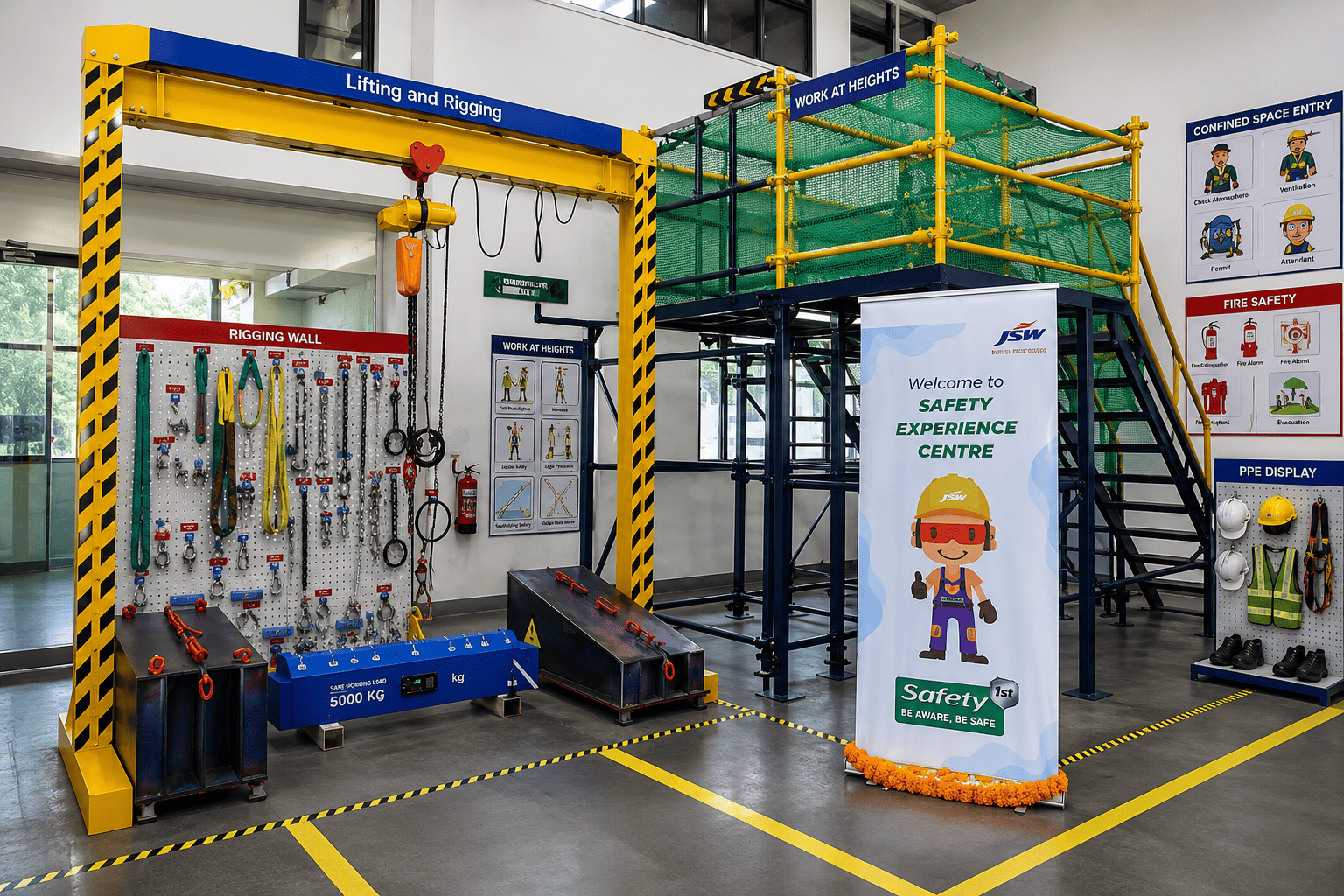
The facility is built around the principle of experiential learning — the idea that people retain knowledge far more effectively when they experience it rather than simply receive it. Across its specially designed zones, workers are not lectured about risk. They encounter it in a controlled, supervised environment that replicates the physical and sensory conditions of real industrial hazards.
A worker does not just learn that falls from height are dangerous; they step onto a platform, feel the height, engage their harness, and experience firsthand why a properly fitted and anchored fall arrest system is not optional equipment but a literal lifeline. The learning is embodied. It bypasses the abstract and lands directly in muscle memory and instinct — which is precisely where safety decisions are made in the real world, under pressure, in a fraction of a second.
The scope of the facility reflects the complexity of JSW Dolvi's own operational environment — a massive integrated steel plant where workers interact daily with hazards spanning height, confined spaces, heavy machinery, electrical systems, fire, chemical exposure, and vehicular movement. Each of these risk categories has been translated into an immersive training zone designed by safety engineers and training specialists who understand both the technical dimensions of the hazard and the pedagogical principles that make training stick.
International Recognition That Means Something
The international recognition the Center has received is not incidental. When the British Safety Council — one of the world's most respected occupational safety institutions — selected it for an International Award, it was acknowledging something specific: that this facility represents a model worth exporting, worth studying, worth replicating. When Harvard Business School described it as one-of-a-kind, it was making a comparative judgment across a global landscape of industrial safety infrastructure. These are not honorary mentions. They are substantive assessments by institutions with the breadth of reference to know what they are looking at.
What It Means for India
For India specifically, the significance cannot be overstated. India is home to one of the world's largest industrial workforces, operating across sectors — steel, cement, oil and gas, construction, power, mining — where daily exposure to serious hazards is simply the nature of the job. Against this backdrop, the Safety Experience Center at Dolvi is not just a trophy for JSW Steel. It is a proof of concept for the entire Indian industrial safety ecosystem: that world-class, immersive, experiential safety training is achievable in India, by Indian industry, for Indian workers.
The ripple effects are already visible. It has sparked conversations in boardrooms and safety committees at other large industrial organisations about what their own training infrastructure should look like. It has raised the expectations of safety professionals across the sector, who now have a tangible reference point when making the case for training investment to leadership teams. It has demonstrated that safety training infrastructure can be a source of institutional pride — something an organisation shows visitors and speaks about publicly — rather than a cost to be minimised.
The Human Story Behind the Awards
There is also a human dimension to this story that numbers and awards do not fully capture. For a worker at a steel plant — often someone who has spent years navigating serious hazards with limited formal safety education — walking through a facility built entirely around their protection is a transformative experience. It communicates something beyond procedure: it says that the organisation values their life enough to invest in understanding how they learn, how they think, and how they can be genuinely equipped rather than merely processed through a compliance checklist. That shift in felt experience has a measurable effect on safety culture, on worker engagement, and ultimately on incident rates.
The Safety Experience Center at JSW Dolvi is not the end of a conversation about industrial safety training in India. It is the beginning of a better one. The question it leaves for the rest of the sector is not whether this standard is achievable — it has already been achieved. The question is who builds next.