In the hierarchy of industrial safety procedures, energy isolation stands apart. Unlike many workplace hazards that can be mitigated through protective equipment, engineering controls, or behavioural discipline alone, hazardous energy has a singular characteristic that makes it uniquely dangerous: it can kill without warning, in a fraction of a second, even when everyone on site believes the equipment is safe to work on. The procedures developed to manage this hazard — Lock Out Tag Out, and its more rigorous successor Lock Out Tag Out Try Out — are among the most consequential safety protocols in any industrial facility.
What LOTO Is — and What It Was Designed to Do
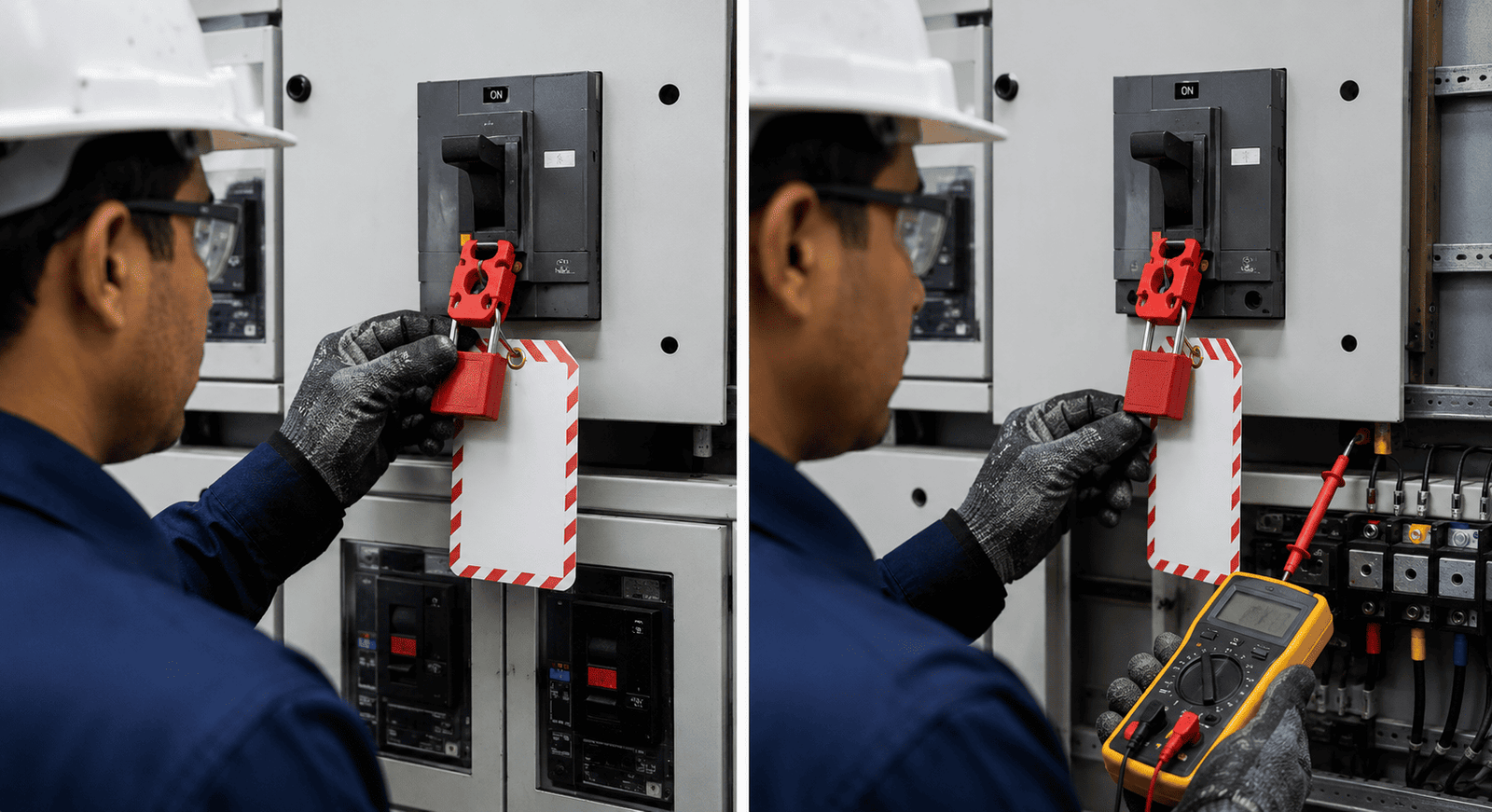
Lock Out Tag Out is the foundational energy isolation procedure. Its logic is straightforward: before any worker performs maintenance, repair, inspection, cleaning, or any other task on equipment where the unexpected energisation or release of stored energy could cause injury, the energy source must be isolated, locked in the off or safe position, and tagged to identify the worker responsible for the isolation. The lock is physical proof that the isolation has occurred. The tag is a communication device that tells every other person on site that work is in progress and that the lock must not be removed by anyone other than the worker who placed it.
LOTO was a significant leap forward when it became formalised as a standard practice. Prior to its adoption, workers routinely performed maintenance on equipment that was simply switched off — relying on a verbal assurance or their own judgment about whether the machine was truly de-energised. LOTO introduced a physical, individual, non-delegable control that removed the assumption from the equation.
The Gap That LOTO Does Not Close
For many years and across many industries, LOTO was treated as the complete answer to hazardous energy isolation. In practice, however, a critical gap remained. LOTO verifies that an energy source has been isolated and locked. It does not verify that the equipment has actually reached a zero-energy state.
This distinction is not academic. Consider each of these real scenarios:
- Capacitors in electrical systems can retain lethal charge after the supply is isolated
- Hydraulic and pneumatic systems can hold dangerous pressure after the supply valve is closed
- Springs and counterweights hold gravitational potential energy that releases unpredictably
- Thermal energy persists in pipework and vessels long after a heat source is shut off
- Process chemicals can exert pressure or react even after feed lines are closed
What LOTOTO Adds and Why It Changes Everything
Lock Out Tag Out Try Out addresses this gap directly. The addition of the Try Out step is deceptively simple in description and profound in implication. After locking out and tagging the energy source, and before any worker begins work on the equipment, the authorised worker attempts to operate or energise the equipment through its normal control interface — the start button, the valve actuator, the control switch. If the equipment does not respond, the isolation has been verified as effective. If it does respond, the isolation has failed, and additional measures must be taken before work proceeds.
For systems with stored energy, LOTOTO requires more than a single try out. Residual hydraulic pressure must be bled and confirmed at zero. Capacitors must be discharged and voltage confirmed at zero with a calibrated tester. Pneumatic pressure must be vented and confirmed absent. Springs must be mechanically restrained. The try out phase encompasses all of these verifications — it is not a single button press but a systematic confirmation across every energy form present in the system.
Which Does Your Plant Need?
The honest answer is that most industrial plants in India need LOTOTO, and many are still operating under LOTO alone. For simple, single-energy-source equipment — a manually operated gate valve on a gravity-fed water line — LOTO may be technically adequate. For the vast majority of equipment found in steel plants, refineries, cement facilities, power plants, chemical processing units, and heavy manufacturing operations — where electrical, mechanical, hydraulic, and pneumatic energy sources often coexist in a single machine — LOTOTO is the correct and necessary standard.
Progressive organisations are not waiting for regulatory mandates to catch up. They are adopting LOTOTO now because the evidence for its superiority over LOTO alone is unambiguous. A procedure written in a safety manual is only as effective as the workforce trained to execute it. The difference between LOTO and LOTOTO requires workers and supervisors to understand the physics of stored energy, the specific residual energy hazards present in each piece of equipment they work on, and the verification methods appropriate to each energy type. This is not knowledge that comes from a toolbox talk. It demands structured, hands-on training delivered by instructors who understand both the regulatory framework and the engineering realities of the industrial environment.